Sustainability by Design - The principal principle of any reference architecture

sustainability | səˌstānəˈbilədē | noun
• the ability to be maintained at a certain rate or level:
the sustainability of economic growth | the long-term sustainability of the project.
• avoidance of the depletion of natural resources in order to maintain an ecological balance:
the pursuit of global environmental sustainability | the ecological sustainability of the planet.
Over the past few years I have been researching, writing and rewriting this article in my mind over and over. I think today is the day I have reached an understanding that I can write this article and want to share it with a wider audience. Most probably, other people have reached a similar understanding of this concept. So why repeat something that is well-known and well-understood?
I think the answer is that I want to make the case that all other design principles, causes, philosophies, and economic paradigms can be reduced or derived from this one principal principle.
Sustainability by Design
I have recently completed the design of a reference architecture that implements the requirements across all six pillars of the Well-Architected Framework Review (WAFR) of AWS:
Operational Excellence
Security
Reliability
Performance Efficiency
Cost Optimization
🍃 Sustainability
principal | ˈprinsəp(ə)l | adjective [attributive]
first in order of importance; main: the country's principal cities.
(of money) denoting an original sum invested or lent: the principal amount of your investment.
Sustainability is the first in order of importance for me and I like to make the case for the reader that if we all put sustainability as the main design principle and derive all other methodologies and principles from sustainability, all other problems are either solved or we have a better chance to solve them. In other words, the main thesis of this article is that if we reorder the priorities of the list of design pillars presented above and start with 🍃 Sustainability first, we would either automatically achieve the other design objectives or have an easier path to implement them.
Background
To set the context, I wanted to share a bit of background on how I came to this understanding working backward from yesterday. I am a programmer and a software engineer by trade. This is the skill that I have developed to be able to sustain my economic life which is tied to my social life. Just like most people I like to be a responsible individual so that I can “maintain” and “adopt” a socio-economic life for myself and my family. For example, on LinkedIn where people go to get a job, there is a section where one would add the causes that they care about.
I have listed only one cause: Environment - and by that I mean the second dictionary definition:
avoidance of the depletion of natural resources in order to maintain an ecological balance.
After all, as a social species we are bounded and dependent on the ecology of our environment. I also wish LinkedIn had added sustainability option as a choice among other causes. Because when I put Environment, that does not mean I do not care about other social or economic causes. To me “sustainability” is the principal principle and all other causes can be derived from sustainability.
This idea has been cooking in my head over the years as I worked across different industries, particularly in FinTech where I started reading about ESG ( Environment, Social, Governance) scores and realizing how problematic this measurement is.
The problem with scores like ESG, or similar composite scores is that they are composite. A composite score combines different dimensions of various problems into one score, and therefore the score can be misleading and prone to manipulation. And moreover, these composite and conflated scores give the wrong impression of the health of a company, society or the overall state of the economy. For instance, if the primary objective of a company is to increase its stock price or profit that is tied to an score like ESG score, then the company can either manipulate the score or compensate in areas that are really not critical for society or economy. To add to this problem, social and governance issues are subjective and varied among different segments of society or cultures and are polarizing in most cases. Take an oil company who has a high ESG score because it has managed to hire C-level executives to just check some checkboxes in certain social and governance issues while its lobbying and environmental practices are creating havoc and disparity in society that in practice is creating wider Social and Governance problems. Or a coffee chain who just uses various messaging toward certain social values - that are also a source of division in the society - just to hide the fact that they have externalized the cost of production, garbage collection and recycling of billions of coffee cups per year to the tax payers and local and foreign governments.
As a result, and given the arguments I am providing below, I am making the case here that the main driving design principle should be E - Environment - and then S - Social, and G - Governance will follow. If we adopt a sustainable behavior with respect to the environment or learn sustainability from nature, then the design of everything else such as Social institutions, Governance structures of our economic paradigms become more sustainable in its broader sense and embodiment.
the ability to be maintained at a certain rate or level
For example, If I design and build my reference architecture with sustainability as the principal principle, then I have done my job correctly. All other design and business criteria will be met.
Academic Background
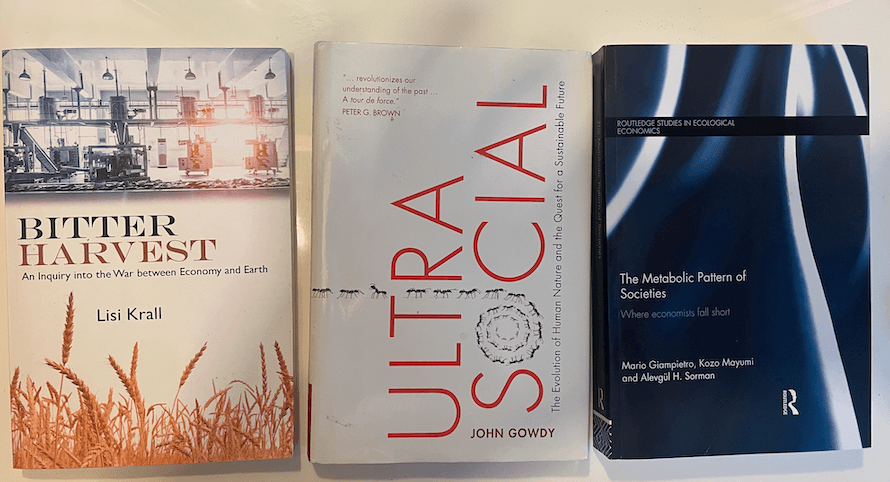
After identifying the problem with scores such as ESG in the industry, I started to research more on this topic. In terms of influential academic works, the intuition behind this idea became clearer to me as I read the works of ecological economists about the origins of our current economic behavior which started from agricultural revolution. To me, the works of ecological economists, such as Lisi Krall, John Gowdy and Mario Giampietro (https://www.coursera.org/instructor/mario-giampietro) are seminal and as a new discipline, their research is of utmost importance and central to any system and architectural design. In fact I am making the case that there should be only one economic discipline: ecological economics - this field is the mother of all other fields of studies. And Most importantly, we have to relearn the forgotten ancient and pre-historic wisdom as our North Star! And maybe literally. How many of us can found our way in nature using the North Star these days - and I don't mean the GPS navigation installed on your car.
After COVID, I watched this talk by Lisi Krall titled: The Hidden Architecture of Economic Order
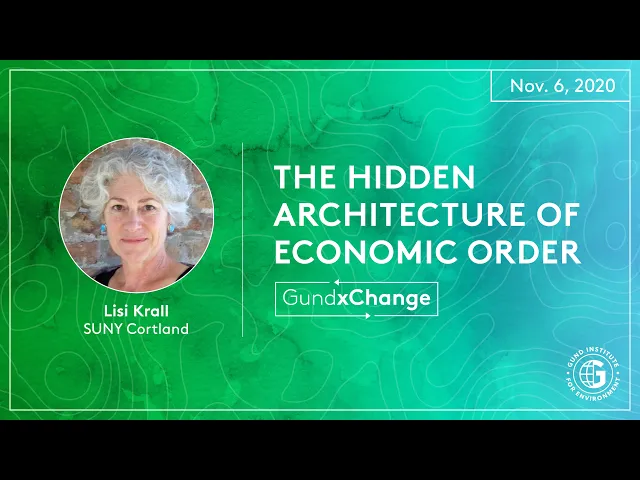
and I followed up on my research with some complimentary courses and readings which solidified my ideas around this topic and the intuition behind system and architecture design.
My Business: ChurnShift Inc.
I founded ChurnShift Inc. last year, and the first question I asked myself was how should I build a start up? That led to a blog post and a sketch of ideas that I am following through as I am learning along the way. Of course the environment was on my mind when I was writing my vision and business planning, but I was not sure how I should build an AI company with a proper architecture that would support my vision.
I had my head down coding and designing a reference architecture over the last year until last week when I completed and passed the AWS Foundational Technical Review (FTR) for designing an architecture that implements the requirements across all six pillars of the Well-Architected Framework Review (WAFR):
Operational Excellence
Security
Reliability
Performance Efficiency
Cost Optimization
🍃 Sustainability
There were many requirements in each pillar, but I told myself that the order of priorities is not right. In fact if I have to reorder this list. So now as my plan of improvements, I decided to anchor all other pillars around Sustainability - which I can call it the order of Sustainability by Design:
🍃 Sustainability
=> Cost Optimization
=> Performance Efficiency
=> Operational Excellence
=> Reliability
=> Security
In the following I will make the case for each pillar and derive them from the broader concept of Sustainability.
Cost Optimization
This is the easiest case to make and the most obvious one that matches the first definition of sustainability. Nobody can have a functioning business if the cost of operation is higher than the revenue or a negative net profit or income. In other words, if you have a business that burns cash more than it makes by selling goods and services, it will simply fail or in betters words the business cannot be sustained.
Unfortunately, we participate in a problematic and irresponsible economic behaviour where most businesses externalize some costs of their business to the tax payers, larger society and eventually the environment in order to be able to sustain themselves in a short-sighted greedy practice. So the thesis of this article is the following:
if a business makes money by externalizing most of its cost to environment, society, and government then it was not designed based on the principle of sustainability as its principal principle.
And by sustainability I mean its encompassing definition which includes environmental sustainability. Humans have always known that nature has the best sustainable design and yet the more we ignore the sustainable design, the more we find ourselves in trouble.
This is the case for most of the startups where at the beginning they spend more without having a positive net income. The rush is to make an MVP and in that rush we overlook many cost optimization design principles by not making sustainable decisions. This will lead to not having a cost- effective and sustainable business.
Last night I recalled my father who used to always remind me of this fact by reciting a poem by Saadi - one of the most beloved poets of Iran.
چو دخلت نیست، خرج آهستهتر کن
که میگویند ملاحان سرودی
اگر باران به کوهستان نبارد
به سالی دجله گردد خشک رودی

"When you have no income, spend less. For the sailors sing a song: If rain does not fall in the mountains, in a single year, the Euphrates will become a dry riverbed" - Saadi
Performance Efficiency
If you have started to truly design your business or technology stack with the broader definition of sustainability in mind, then the business will be efficient and performant in its true economic sense. In other words, if our technological stack is not performing efficiently it was because we did not make sustainable design choices at the begging which leads to a business that is not economically sustainable down the road. Before making a soda can we must think of sustainability and do not kick the can down the road.
To kick the can down the road means to delay dealing with a difficult problem or making a hard decision in the hope that it will resolve itself or become someone else's responsibility.
Operational Excellence
Using the same reasoning, your business will have Operational Excellence if it is sustainable in every sense. It will have enough cash flow to operate, it is cost effective and that means you do not have to make extra effort or spend more to keep it operational.
Reliability
reliability | rəˌlīəˈbilədē | noun
• the quality of being trustworthy or of performing consistently well: the car's background gives me every confidence in its reliability.
• the degree to which the result of a measurement, calculation, or specification can be depended on to be accurate: these data throw doubt on the reliability of national statistics.
A business that signals a society and its customers that it is truly a sustainable business, will gain the trust of its customers, and since it does not have detrimental side-effects on other parts of society or nature, it will not have adversaries, litigations against it, and will be more prosperous which makes it perform consistently.
In terms of software, a software that is not resource-hungry and efficient will be more reliable and it will have less incidents of crashes due resource exhaustion and therefore it will be more reliable. And at the design stage, the sustainability principle will force the designer to think ahead about any necessary component that are needed to make it more reliable.
Security
When you design a cost effective business (or in my case software business), that means you are designing it in a way that it will avoid expensive security incidents. The larger the business, the more evident this fact becomes. If you build an entire industry - like a fishery - but do not care about the river or ocean sustainability you have to deal with food insecurity, social unrest ( less social security) and sometimes it is not even cost effective to completely abandon an entire set of factories or a town because sustainability was not considered in the first place. So you have to bake-in all the essential security using the first principle because you know if it is not secure (in any form) it will cost you more down the road.
Conclusion
In conclusion, if any small, medium or large business, any private or public institution, any piece of technology, software or hardware or economical paradigm or policy is designed with sustainability as its first and most important design principle - in its broader definition which is inspired by nature as a truly sustainable design - then everything else will fall into place. Of course this is the goal, but to get to that goal I believe every small or big design decision needs to be guided by the principal principle of sustainability.
So I end this post with the same hope and thinking as when I hatched the ChurnShift plan a year ago except that after a year of designing a reference architecture for a modern AI company the principal principle has become clearer to me. I have identified the actual guiding design principle and I have incorporated it in my architecture as much as I could, and now I am trying to figure out how I can apply the same principle to create a positive cash flow where the business model is sustainable as well.
Warm heart: Contribute to a Nature-Positive Economy
Obviously, the path that was laid out in my original plan is not a method that is practiced, or most popular and maybe not openly endorsed - even if - there are founders who believe in it wholeheartedly or like some parts of it. These days most startups fail, and the ones who make it have such huge valuations in a winner takes all scenarios that they would add exponentially to the disparity. And I believe almost all founders - the ones who make it and the ones who won't - have innocent and good intentions in mind, but somehow along the way things turn out in a way that what they create has a net-negative effect on society and/or environment. So these were just some ideas to think about them in advance, and I think if we set our goals with a warm heart and work toward those goals with cold reasoning (like axiomatic logic) we might be able to be part of a future Nature-Positive economy and avoid any unintended negative effects on society and environment.